


Anyone working on a modern onboard energy system will sooner or later encounter the question: Do you stick with 12V or 24V, or is it time to make the move to 48V?
For many years, 12V was the logical standard for boats. This still works perfectly for simple installations, but as soon as the power demand increases, a low-voltage system quickly reaches its limits.
Think of air conditioning, induction cooking, water makers, powerful inverters, large lithium battery banks, and charging with a high output alternator. That's precisely when 48V becomes seriously interesting.
48V is not a hype, nor is it a solution for every boat. It is primarily a smart choice for larger or more heavily loaded systems, where efficiency, load capacity, and tidier wiring truly make a difference.
In dit artikel leggen we uit waar die voordelen vandaan komen, wanneer 48V logisch is en waarom steeds meer serieuze energiesystemen op het water deze kant op bewegen.
What actually changes with 48V?
The core idea is simple. For the same power, you need less current at a higher voltage. Electrical power is voltage multiplied by current. So if you power the same device or charger at 48V instead of 12V, the current drops significantly.
In practice, this means that a load of 4,800 watts at 12V requires approximately 400 amps, whereas the same 4,800 watts at 48V only requires around 100 amps.
That's a huge difference for your complete installation. The lower current is precisely why 48V is becoming particularly attractive as soon as the system needs to handle serious power.
That difference isn’t just apparent in theory, but in almost everything around it. Busbars, fuses, main switches, dynamo charging, DC distribution and cable runs are simply much more manageable when the currents stay lower. And that’s especially important on a boat, where space is limited and reliability is crucial.
More efficient system, less standby power
One of the biggest advantages of 48V is that you have fewer losses in the DC installation. Because the current is lower, cable losses decrease. These losses increase quadratically with the current, so anyone who significantly reduces the current gains relatively a lot.
You'll notice this in practice in three ways:
✔️ less heat in cables and connections
✔️ less voltage drop over longer distances
a system that under heavy load quieter and more efficient works
This is especially relevant on boats where the battery bank isn't located directly next to all the heavy consumers. At 12V, the currents with larger inverters or heavy charging currents rise so steeply that every bit of resistance starts to count. At 48V, this remains much better under control.
The result is a system that is technically more elegant and wastes less energy on unwanted heat.
Thinner cables and a neater installation
Lower current also means you can work with thinner cables for the same power, as long as the cable length, protection, and permissible voltage drop are correctly calculated.
👍🏼 That often makes an installation not only neater, but also more practical.
Thicker cables are more expensive, harder to pull, more difficult to finish in engine compartments, and require heavier connection components. At 48V, you can reduce some of that complexity.
This does not mean you should cut corners on cable quality. Correct sizing remains essential even at 48V. However, where with 12V you quickly end up with very substantial cable cross-sections at higher power levels, a 48V system remains much more manageable.
This is a big advantage, especially on longer routes or with a central battery bank.
At higher power outputs, often a more logical cost structure.
Many people think that 48V is automatically more expensive. That's too simplistic. The battery voltage in itself doesn't tell you everything about the total system costs.
In light installations, 12V is often still the simplest and most cost-effective route. But as soon as the power levels increase, that picture changes. With 12V, you'll actually end up paying for heavy cables, larger fuses, heavier distribution, and sometimes complicated solutions to keep charging currents and peak consumption manageable.
At Victron Furthermore, you'll notice that the 48V range is now extensive and mature. There are 48V power supplies, inverter chargers, MPPT solutions, and DC-DC converters available, allowing you to build a powerful system without exotic components.
Even at the edge of the system, the story is strong. Victron, for example, has converters available to easily power a 12V network for existing equipment.
This allows you to combine a 48V main system with a compact 12V sub-circuit for navigation, lighting and other onboard equipment.
- Deal!
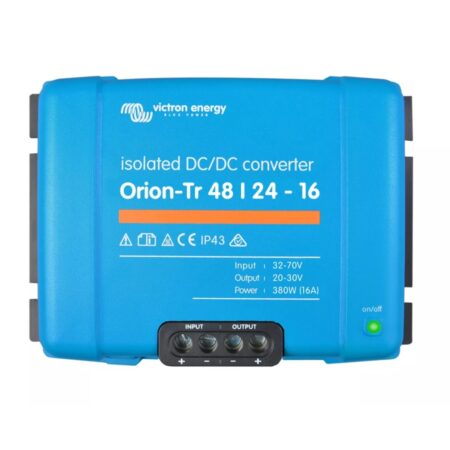
Victron Orion-Tr Smart 48/24-16A Isolated
0 Reviews€ 269,00Oorspronkelijke prijs was: € 269,00.€ 239,00Huidige prijs is: € 239,00. - Deal!
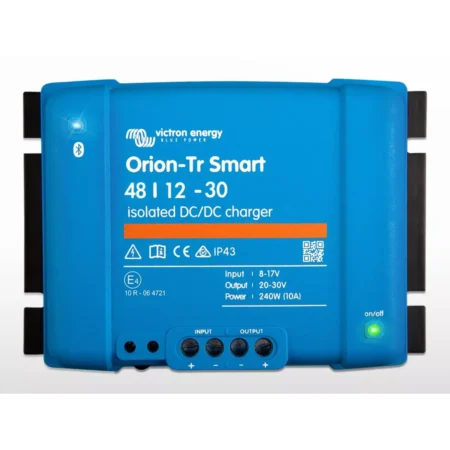
Victron Orion-Tr Smart 48/12-30A isolated
0 Reviews€ 269,00Oorspronkelijke prijs was: € 269,00.€ 239,00Huidige prijs is: € 239,00. - Deal!
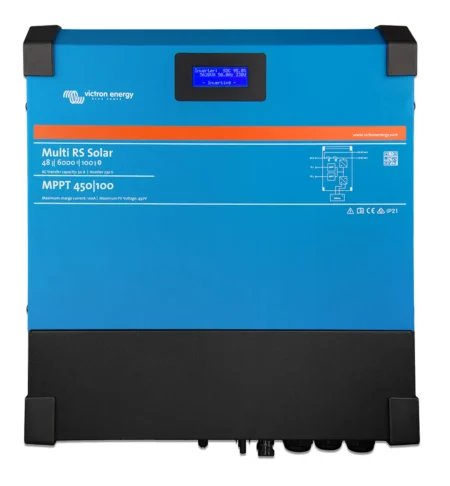
Victron Multi RS Solar 48/6000/100-450/100
0 Reviews€ 1.799,00Oorspronkelijke prijs was: € 1.799,00.€ 1.699,00Huidige prijs is: € 1.699,00. - Deal!
Victron MultiPlus-II 48/6500/100-50 230 Volt
0 Reviews€ 1.119,00Oorspronkelijke prijs was: € 1.119,00.€ 859,00Huidige prijs is: € 859,00.

The A8000 from Arco Marine makes 48V onboard charging much more interesting.
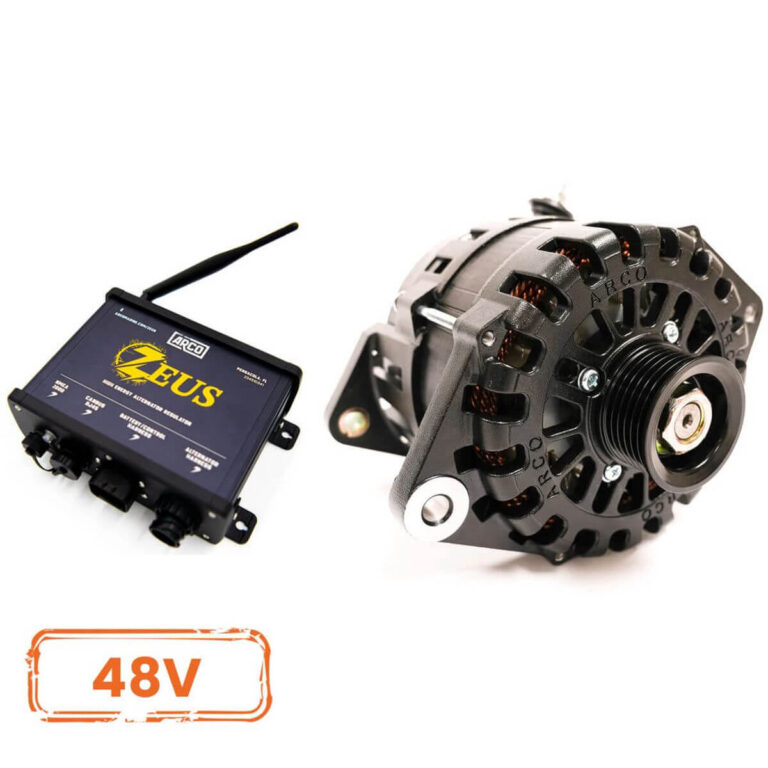
Where 48V really becomes interesting is when charging under the motor. And that's precisely where the Arco Zeus A8000 in sight.
This High output 48V dynamo is developed for applications where traditional charging solutions fall short.
The A8000 can deliver over 5 kW of charging power and is designed to charge large lithium battery banks quickly and efficiently. Thanks to the higher system voltage, the currents remain relatively low, making the system technically much easier to manage.
For boats with high energy consumption, this could be a massive step forward.
Rather than slow charging with a conventional dynamo, a powerful 48V dynamo can bring a battery bank back up to charge in a relatively short time.
Fewer generator hours
A powerful 48V system becomes particularly interesting if you consume a lot of energy and want to replenish that energy quickly.
Large inverters, cooking on induction, air conditioning, hot water and anchoring for extended periods all require a serious energy balance.
Then you don't want to wait endlessly for the battery to recharge.
A 48V battery bank, combined with a powerful alternator, suitable controller and Victron charging infrastructure, allows for higher charging capacities without the DC side getting out of hand.
For liveaboards, larger sailing yachts and catamarans, this often means fewer generator hours and a more efficient energy system.

12V vs 24V vs 48V: which system voltage is right for your boat?
Which system voltage is best primarily depends on the total energy consumption on board. The higher the power you want to use or charge, the more interesting a higher system voltage becomes.
12V systems
12V is still the most commonly used on-board voltage, especially on smaller boats and in simple installations.
Advantages of 12V:
✅ Very wide range of equipment available
✅ Easy to install
✅ compatible with virtually all marine electronics
✅ ideal for smaller battery banks
Disadvantages of 12V:
❌ High currents at higher power ratings
❌ Thick cables required for powerful inverters
❌ less efficient for high energy consumers
12V works best on boats with a relatively limited energy consumption, such as lighting, navigation equipment, a refrigerator, and a small inverter.
24V systems
24V often forms an intermediate step between 12V and 48V and is widely used on larger yachts or in commercial applications.
Advantages of 24V:
✅ lower currents than with 12V
✅ more efficient at medium powers
✅ cable diameters can remain smaller
Disadvantages of 24V:
❌ still relatively high currents with large inverters
❌ fewer devices available than with 12V
❌ not yet ideal for very large systems
24V is often a good choice for boats with medium energy needs, for example when larger battery banks or inverters are used.
48V systems
48V is becoming increasingly popular for modern energy-intensive onboard systems.
Advantages of 48V:
✅ much lower currents
✅ considerably less energy loss
✅ thinner cables possible
✅ Ideal for powerful inverters & large battery banks
✅ suitable for high loads
Drawbacks of 48V
❌ less suitable for small installations
❌ Often an extra DC-DC converter is needed for 12V equipment
48V is mainly beneficial on boats with high energy consumption, for example in systems with air conditioning, induction cooking, watermakers, large lithium battery banks and powerful inverters.
Summary
In practice, you often see the following pattern:
| Type boot | Most used system |
| Small sailboat or motorboat | 12V |
| Mid-sized yachts | 24V |
| Large energy-intensive systems | 48V |
Hybrid solution
Increasingly, a hybrid solution is also chosen. Here, 48V forms the basis for the battery bank, charging, and heavy consumers, while a 12V network supplies the existing onboard equipment via a DC-DC converter.
This way, you combine the efficiency of 48V with the compatibility of 12V equipment.
Need advice or help?
We are known for our customer-focused approach and excellent service!
48V on-board is particularly interesting for those who look beyond just the battery voltage.
It's about the overall picture: less current for the same power, fewer losses, less voltage drop, more manageable cabling, and a system that is much better suited for high power outputs.
Combine this with Victron's 48V battery supply and a powerful charging solution like the Arco Zeus A8000, and you get a platform ready for modern onboard energy needs.
For simple boats, 12V will continue to work fine. But for larger lithium systems, powerful inverters and fast charging under the engine, 48V is increasingly the smarter route. Not because it's fashionable, but because it forms a technically stronger foundation.
At Smartmarine, we understand that your on-board power requirements are unique. We offer not only a wide range of on-board power products, but also expert, bespoke advice. Our experts are on hand to help you choose the right configuration for your specific situation. Whether it’s a small installation or a comprehensive system for harsh conditions, we ensure that your system performs optimally and meets all your requirements.
We are known for our customer-oriented approach and excellent service. When you buy from us, you not only get the best product, but also support with installation and any questions after purchase.


