



Anyone who regularly travels with their boat or motorhome knows how important a reliable electrical system is.
The fridge, lights, navigation, inverter, heating or air conditioning - they all require energy.
As long as your engine is running or you are on shore power, this does not seem to be a problem.But once you spend days at anchor, camp off-grid or have switched to lithium batteries, the standard alternator soon runs into its limits.
We notice this every day at Smartmarine: customers who notice that their alternator is getting hot, that charging is taking a long time, or that their batteries are no longer getting fully charged.
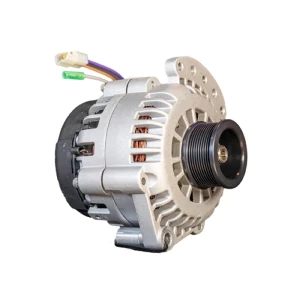
In this article, we answer step by step the most frequently asked questions about high output alternators and regulators.
We explain what they do, how they work together, and what choices are important for a reliable charging system.
Whether you sail, travel or both: with the right alternator and regulator, you charge faster, safer and smarter.
Table of contents
What exactly does an alternator do?
An alternator converts the mechanical energy of your engine into electricity.This is done via a rotating magnetic field that generates voltage in the alternator's coils.That voltage is converted to direct current via a rectifier, which charges your batteries.
In standard installations, the main purpose of the alternator is to recharge the starter battery after starting the engine.But as soon as more consumers are added - such as refrigerators, bow thrusters, lights, pumps, inverters or lithium batteries - much more power needs to be supplied.
👎🏻 A standard alternator usually cannot handle this for long periods of time. It is designed for short use at low load and quickly overheats in continuous use. To protect the alternator from this, a DC-DC charger is needed anyway, these limit the charging capacity of the standard alternator.
👍🏻 A high output alternator, on the other hand, is specially built to deliver high charging currents for long periods of time. It ensures that your batteries are reliably and quickly charged even in harsh conditions.

What is a high output alternator?
A high output alternator is, simply put, a professional, heavy-duty alternator.It continuously delivers high charging currents - often two to four times more than a standard model - without overheating.
The difference is in the details:
- Heavier bearings that can withstand long-term loading.
- Copper windings with higher temperature resistance.
- Improved cooling via modified air currents or an external rectifier.
- More precise control of the field voltage so that efficiency remains optimal.
In practice, this means that a high output alternator will have no problem 150 to 300 amps can deliver, where a standard alternator gives up after 30-60 amps.
At Smartmarine, we work with two brands that have proven themselves in this regard:


Both supply high-quality alternators specifically designed for long-term, intensive loading in the marine and RV sector.
Why is a standard alternator not enough?
Many people first try to improve their existing alternator with a smart regulator.That seems attractive - cheaper and quick to fit - but in practice it often turns out not to be a sustainable solution.
A standard alternator is designed to operate briefly at full power.When it is continuously under heavy load, the following happens:
🌡️ The temperature is rising fast.
🥵 The rectifier overheats.
🔥 The stator windings burn out.
👹 The bearings lose their lubricant.
💥 The result: the alternator breaks down.
With a high output alternator, everything is correctly tuned for continuous use ✌🏻.Ventilation is improved, the materials are stronger and the coils better insulated.Therefore, the output remains stable even after hours of charging at full power.
In short: A standard alternator can sometimes do it for a while, but a high-output alternator is made for it.
Why choose Smartmarine?
We at Smartmarine Have been working with charging systems for years, both on boats and motorhomes.We have seen what works - and what doesn't.That is why we have put together a range of reliable products who in proven in practice have. We do not believe in one universal solution.
Every installation is different:
- one customer has a sailboat with 48V lithium banks,
- the other a motorhome with 12V AGM batteries,
- yet another wants above all to be able to anchor quietly without generator noise.
💁🏼 We look at the whole system: alternator, regulator, batteries, solar panels and usage pattern.Only then do we recommend the right combination.
Our motto: invest well once, load worry-free for years 🤓
What are the differences between 12V, 24V and 48V alternators?
The voltage of your system determines which alternator is suitable.
12V systems - the most common
Most boats and motorhomes operate on 12 volts.This is sufficient for most consumers, but requires higher currents at higher powers.Therefore, it is extra important that the wiring and connections are done properly.
| Electromaax Cruiser | Entry series, 120-160A, available in Foot or Saddle Mount. |
|---|---|
| Electromaax Genmaax | 215-250A, optionally with Remote Rectifier for more efficient cooling. |
| Arco 275L | 275A, delivers high current even at low rpm, with unique air-cooled design. |
| Arco 225S | 225A, affordable, powerful alternator with various mounting options. |
24V systems - for tougher applications
24 volts is often used on larger yachts, commercial vessels or motor homes with heavy electrical installations.The higher voltage means lower current ratings and therefore less heat and voltage loss.
| Electromaax Cruiser (70A) | Compact and quiet. |
|---|---|
| Electromaax Genmaax (165A) | Powerful, with Remote Rectifier. |
| Arco A4000LTO (100A+) | Outstanding at low revs, ideal for anchor use. |
| Arco A7000 | Delivers extra power at higher revs. |
48V systems - the future
In recent years, more and more users are switching to 48 volts.This is due to the emergence of powerful lithium systems and large inverters.With 48V, cables are thinner, losses smaller and efficiency higher.
| Electromaax Genmaax 48V (70A) | Newly developed, with Remote Rectifier. |
|---|---|
| Arco A8000 | Most powerful model, available for both yachts and motorhomes. |
A point of interest at 48V is that the alternator needs higher speeds to get voltage.We take this into account at Smartmarine when determining the pulley ratio.
What do terms like 'mount' and 'remote rectifier' mean?
In the technical specifications, you often see terms that deserve explanation:
Mount: the way the alternator is attached to the engine.
- FM (Foot Mount) (SF) - single-foot mounting, often on smaller engines.
- SM (Saddle Mount) (3.15) - double attachment on both sides.
- JM (J180 Mount) (DF4) - industry standard, used on heavy and newer engines.
Remote Rectifier: means that the rectifier (which converts alternating current to direct current) is not in the alternator itself, but is cooled separately.This lowers the temperature in the alternator and increases charging efficiency.
An alternator with Remote Rectifier can usually be set as P- or N-type:
- P-type: positive side grounded.
- N-type: negative side grounded.
This makes them usable on both insulated and uninsulated motors. The Arco range is optionally available in both.
How do I choose the right alternator?
Choosing a good alternator is tailor-made.That is why we always ask a few questions to understand your situation properly:
- Engine: which type do you have, and which belt drive (V-belt, multi-rib, double belt)?
- Tension: Are you working with 12V, 24V or 48V?
- Batteries: what type are you using (lead, AGM, lithium) and what is the capacity?
- Grounding: do you need a ground-free alternator or one with ground on the housing?
- Consumption: how many Ah do you use per day, and how often do you recharge?
- Future: Are you expecting expansion, switching to lithium, or longer trips off-grid?
The better we know your usage, the more precisely we can recommend an alternator that suits your current and future needs.
What does a controller do?
The regulator (or ‘smart regulator’) is the brains 🧠 of the system.It determines how the alternator behaves: how much voltage and current is delivered, and at what time. This is easy to monitor on your phone with the accompanying app.The regulator matches this to the battery type, temperature and charging stage.
A good regulator prevents overcharging, optimises efficiency and ensures that batteries are safely and fully charged. This is especially important with lithium batteries, as too high a voltage or temperature can cause damage.
Which controllers are there?
At Smartmarine, we work with three proven controllers:
⭐ Electromaax Promaax X
⭐ Wakespeed WS500
⭐ Arco Zeus
All three are suitable for both marine and RV applications, but each has its own character.
What are the differences between the Promaax X, WS500 and Zeus?
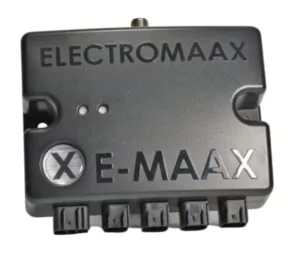
Electromaax Promaax X
Simple, reliable and complete.
✅ Affordable and comes with cables and shunt.
❌ Configuration only via USB and Windows laptop.
❌ Limited Wi-Fi monitoring.
Perfect for smaller systems or those who appreciate simplicity.
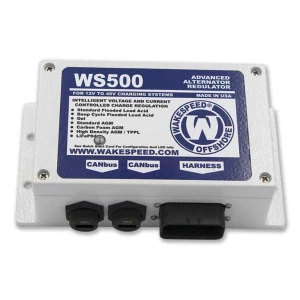
Wakespeed WS500
Powerful and well-known for its Victron compatibility, but requires a bit more technical knowledge.
✅ Fully Victron compatible.
✅ Suitable for both marine and RV.
❌ Set via dip switches.
❌ Accessories (shunts, cables) available separately.

Arco Zeus
Our best-selling controller - powerful, smart and easy to use.
✅ Fully Victron compatible.
✅ Bluetooth and app for configuration.
✅ Generator mode: temporary charging at full power.
✅ NMEA output for readout in displays.
❌ Shunts available separately (often already present).
The Arco Zeus combines the power of high-end controllers with ease of use.Designed for both the marine and RV industries, it offers the best price-performance ratio.
Which combination fits my boat or motorhome?
| Use your lithium batteries? | Always choose a high output alternator with smart regulator (like Arco + Zeus). |
|---|---|
| Have you lead-acid or AGM batteries? | Then a simpler combination will often suffice, for example Electromaax Cruiser with Promaax X |
| Do you work with Victron-equipment? | The Arco Zeus is the logical choice because of its full compatibility. |
What is Smartmarine's advice?
You don't buy an alternator or regulator every day and a wrong choice can lead to unnecessary costs or damage.That's why we at Smartmarine believe that good advice is half the battle.
The more we know about your bike, batteries and usage, the better we can advise which combination fits best.
Feel free to send us a message with the details of your installation.Then Henk will make sure you get a solution that suits your boat or motorhome - so you can charge quickly, safely and efficiently, today and five years from now.


